Do you know what is common between Ronald Reagan, MTV and Autodesk?
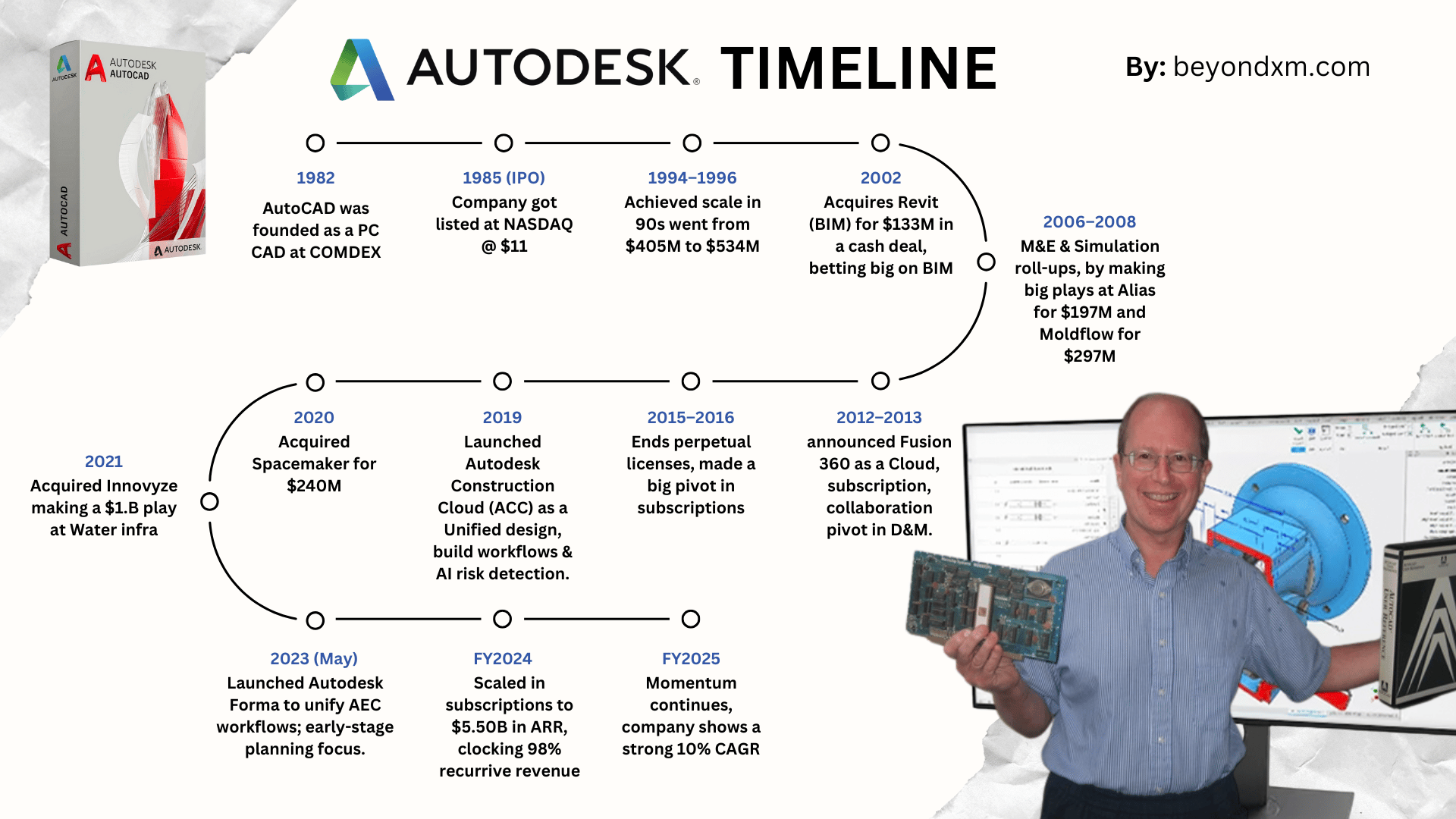
Autodesk Business Journey Timeline
In 1982, Ronald Reagan was president, MTV was still playing music videos, and in an unrelated intersection, 13 programmers decided to pool their pocket change, a modest $59,000, to chase what seemed like the most niche dream imaginable, the origin of CAD software company, Autodesk.
John Walker, the head of this crew, wasn't even trying to build a CAD empire. The man was more interested in creating office automation software called "Autodesk", yes, that was supposed to be the product name, not the company. AutoCAD was just a side project, something they figured they could knock out quickly for a December 1982 trade show.
Did you know that John Walker acquired the core technology for Autodesk from Michael Riddle for merely $1 plus 10% Royalties?
Unique Survival Quality: Art of Strategic Self-Destruction
The Subscription Revolution Nobody Wanted: They systematically killed their most profitable business model, while transitioning from one-time software purchases to recurring subscriptions; but, By deliberately cannibalizing their cash cow, they built something far more valuable, predictable, recurring revenue that scales infinitely.
The AI-First Pivot in a 42-Year-Old Company: While startups scramble to add AI features, Autodesk has been quietly building AI capabilities for over a decade. Since 2009, Autodesk's industrial research lab has published over 65 peer-reviewed research papers, making the Autodesk Research AI
Did you know that John Walker is claimed to be the first creator of a computer virus, when he created the program ANIMAL in 1974, which crashed 1100 UNIVAC machines accidentally?
Wins Against all Odds:
The $875 Million PlanGrid Gamble (2018): When Autodesk acquired PlanGrid for $875 million, industry observers called it massively overpriced. But Autodesk wasn't just buying software, they were buying the future of construction. PlanGrid had cracked the code on field-based productivity, something traditional BIM software couldn't even imagine.
The Alias Coup (2006): The acquisition of Alias brought major film studios and game developers, such as Industrial Light & Magic, DreamWorks SKG, Weta Digital, Sony Pictures Imageworks, Electronic Arts, Midway Games, Nintendo and SEGA directly into the Autodesk ecosystem. With this move, Autodesk owned the creative pipeline from concept to screen in Hollywood.
The Manufacturing Play: Autodesk has completed 56 acquisitions so far, with an average acquisition amount of $231M. Each acquisition wasn't random, they were building an integrated ecosystem before anyone understood what that meant.
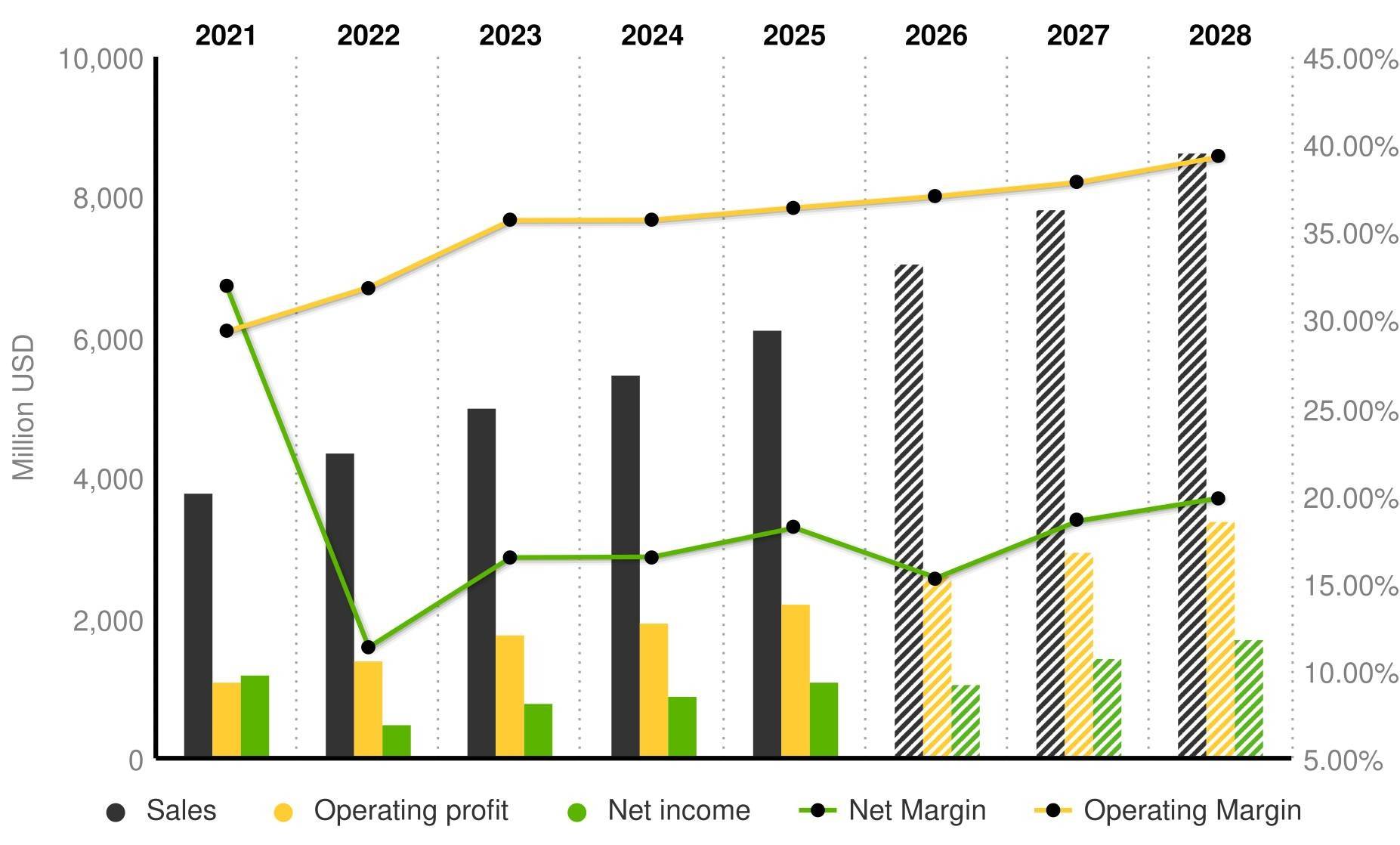
Source: S&P Global, Autodesk Business Projections
Did you know that after achieving significant success in late 80's, in 1991, Walker moved to Alps, while the company went through business transition?
5 Secret Hacks Autodesk used to create value of $41 Billion
Profitability over Perfection: Walker's $1,000 AutoCAD pricing wasn't about undercutting competitors, it was about creating a completely new market. While competitors fought over enterprise accounts, Autodesk democratized entire industries. Takeaway: Sometimes the biggest opportunity is in making expensive things accessible, not in making good things perfect.
Pragmatism: Crazy, right?, but here comes the best part; Autodesk's transition from perpetual licenses to subscriptions was financially painful but strategically brilliant. They deliberately destroyed their most profitable revenue stream to build something more valuable. Takeaway: The companies that survive longest are willing to cannibalize their own success before market forces do it for them.
Right Talent:Walker managed "18 coders, all very expressive, with their own ideas" by giving them big problems to solve, not by forcing conformity. Takeaway: Innovation comes from creative tension, not consensus. Great founders create environments where brilliant people can argue productively.
Strategic acquisitions: Autodesk was most active in 2014, with 8 acquisitions completed in that year. But look at the pattern, each purchase added a specific technical capability or market access. Takeaway: Strategic acquisitions should fill gaps in your vision, not just eliminate competitors.
Timing: While others debate whether AI will transform their industries, Autodesk has been building AI capabilities for 15+ years. The AI-enhanced design tools market is projected to grow from $5.54 billion in 2024 to $40.15 billion by 2034, and Autodesk is perfectly positioned now. Takeaway: The best time to invest in transformative technology is before it's obviously transformative.
Subscribe to
Beyond Stack
Join Over 10,000 Readers where we share insight to grow your company, build products. Get access to growth hack pitch decks and more.
Thank you! Your submission has been received!
Oops! Something went wrong while submitting the form.