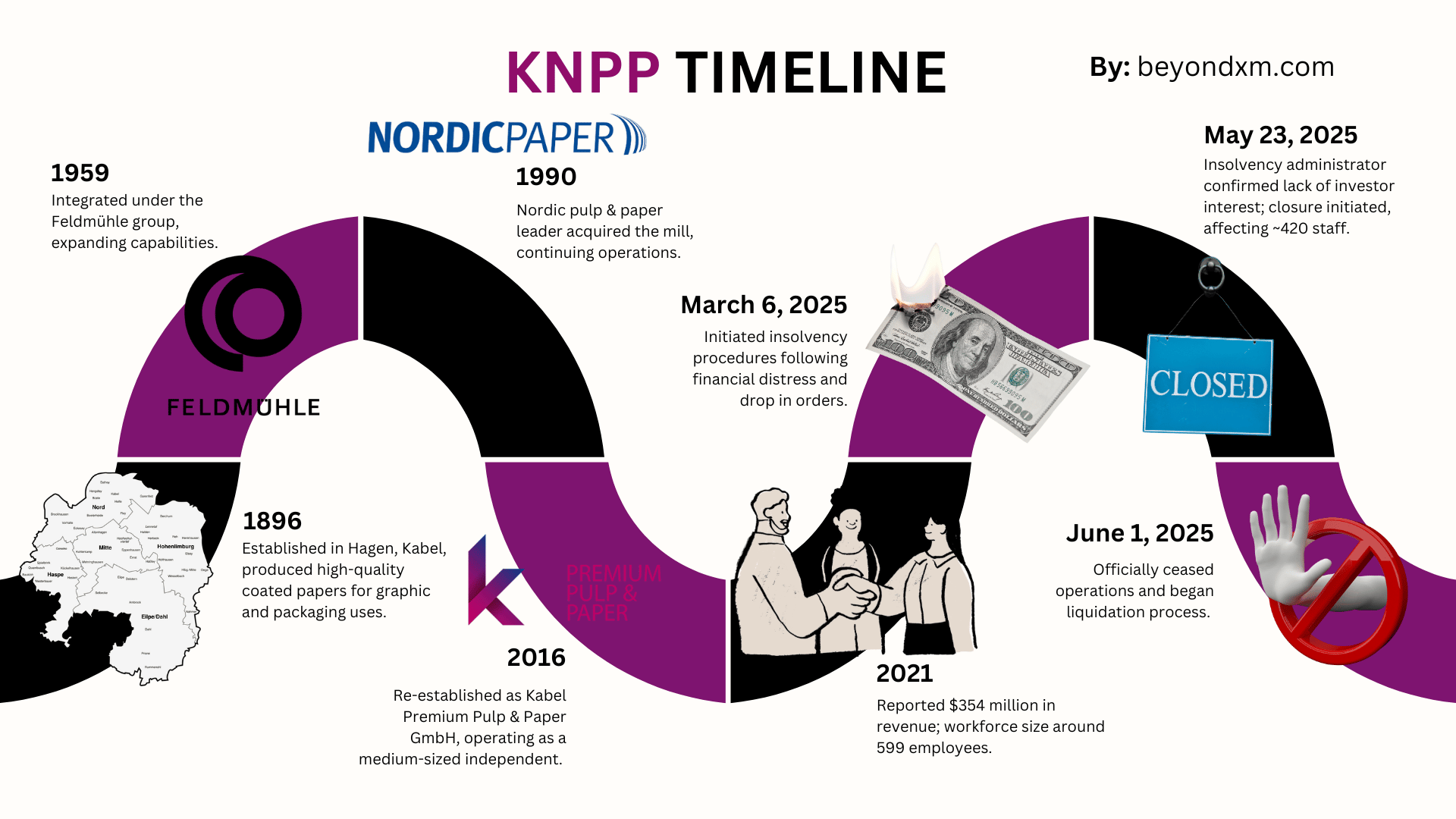
Did you know that KNPP Paper & Pulp first developed the waterproof paper used in the original D-Day invasion maps during World War 2?
KNPP Business Journey
Founded in 1907 by Karl Nilsson and Peter Peterson (the "KN" and "PP" in the name), KNPP started as a small Wisconsin mill with a unique approach, a vision to create speciality papers that solved specific industrial problems, not just commodity products. For decades, KNPP dominated the speciality paper market with its iconic blue packaging, using this business approach. It gained so much credibility in the Industry that Allied commanders trusted the durability of KNPP's patented moisture-resistant treatment over any other brand for their critical paper needs.
Did you know that, by the 1980s, KNPP was generating $1.2 billion in annual revenue with profit margins twice the industry average?
Research Focus: Maintained the industry's largest R&D lab with 120+ scientists.
Process Innovation: Pioneered closed-loop water recycling decades before competitors.
Patent Portfolio: Held over 300 patents for specialised paper treatments and manufacturing processes.
Family Ownership: Remained family-controlled for 87 years, enabling long-term planning.
Did you know that in 1989, a KNPP employee, Sarah Lehrman, proposed expanding into digital document management, but was dismissed as “outside our core." She left, founded DocuSystems, and sold it to Adobe for $440M in 2002
The $235 Million Failure:
In 1995, KNPP made a fateful move that would ultimately accelerate its downfall: investing $235 million in expanding its print publication paper capacity. The timing couldn't have been worse. Three market forces were converging to undermine KNPP's core business:
Digital Transformation: Newspapers and magazines, major customers, began experiencing circulation declines
Global Competition: Low-cost producers in Asia entered the market with government subsidies
Environmental Pressures: New regulations increased compliance costs while changing consumer preferences
The Gradual Erosion Was Painful to Watch
1998: First quarterly loss in 22 years
2003: Closure of three smaller mills, 1,200 jobs eliminated
2008: Sale of timberlands to raise capital
2015: Chapter 11 bankruptcy protection
2018: Liquidation of all remaining assets
Total loss: Over $800 million in shareholder value erased
"We're betting on the permanence of print. The internet is primarily for entertainment, serious reading, and information will always require paper." — Richard Nilsson, KNPP CEO (1992-2003)
5 Mistakes that caused the $800 Million collapse of KNPP
Underestimating Markets: Focused on five-year forecasts that simply extended past performance while ignoring emerging digital disruption. Who's Doing It Right? International Paper, diversified into packaging and speciality products early, reducing exposure to declining print markets
Product Innovation: KNPP defined their business as "paper manufacturing" rather than "information storage and communication". Who's Doing It Right? Fujifilm, transformed from a photography company to a diversified business in healthcare, electronics, and materials, when film declined
Financial Intelligence: KNPP made a single massive bet on print paper expansion rather than staged investments. Who's Doing It Right? 3M, maintains a portfolio approach to capital allocation, with investments across different time horizons and risk profiles
Brand Positioning: They allowed institutional pride in their heritage to block acknowledgement of market changes. Who's Doing It Right? Microsoft, under Satya Nadella, explicitly rejected the "Windows-first" mindset to embrace cloud and cross-platform strategies
Losing People Capital: Lost forward-thinking employees who saw the coming disruption but couldn't influence strategy, failing to create pathways for employees to explore adjacent opportunities within the company Who's Doing It Right? Amazon's "two-pizza teams" and internal incubation processes give innovative employees alternatives to leaving
Subscribe to
Beyond Stack
Join Over 10,000 Readers where we share insight to grow your company, build products. Get access to growth hack pitch decks and more.
Thank you! Your submission has been received!
Oops! Something went wrong while submitting the form.